

Deciding Which Early TE To Draft

As is the case every summer, I’m finding myself powering through mock drafts, trying to design different strategies for an idea of what to prepare for at the end of August when the real drafts begin. In every mock so far, without fail, I’ve reached the 2-3 turn and suddenly I’m the Jedi’s prodigal son with Chancellor Palpatine trying to convince me to behead Count Dooku with his own lightsaber. Personally, I think if I were in that position, I would’ve remembered my training, had the presence of mind to realize that the Chancellor was playing me like a fool, arrested both him and Dooku, returned home as a hero, saved the galaxy from decades of war, gain a seat on the council WITH the rank of master and celebrated happily in the arms of Natalie Portman. I may have gotten SLIGHTLY carried away with that analogy, so let me explain. I am Anakin Skywalker. Early round TEs are our Count Dooku. The 2-3 turn is the lightsaber I’m holding to Dooku’s head. The voice in my head spurring me to draft a TE uncomfortably early is Chancellor Palpatine. My future wife is Natalie Portman (call me). Does most of this make absolutely no sense whatsoever? Good. Let me start speaking your language.
Early TEs are defined in their average draft position (ADP) every year and you can see the cutoff point between these early TEs and the rest of the position. In 2024, there were almost 2 full rounds between the TE2 Sam Laporta and the TE3 Trey McBride. In 2023, Travis Kelce was the consensus TE1 going in the middle of Round 1 and T.J Hockenson, the TE3, was going at the start of Round 5. The margins are incredibly wide, but for good reason. By taking a TE early, you lock in an almost guaranteed advantage over the rest of your league mates. Take 2025 for example. According to last year's ADP, there were 3 TEs drafted in the first 3 rounds. Trey McBride averaged a staggering 14.9 PPG (points per game) in half PPR formatting. Brock Bowers? 12.0 PPG. George Kittle? 12.1 PPG. Since Bowers and Kittle both missed multiple games last season, they finished as the overall TE9 and TE13 in total fantasy points. In 2025, the TE2 through TE8 in total points (highlighted in orange below) averaged between 8.8 and 10.3 PPG.
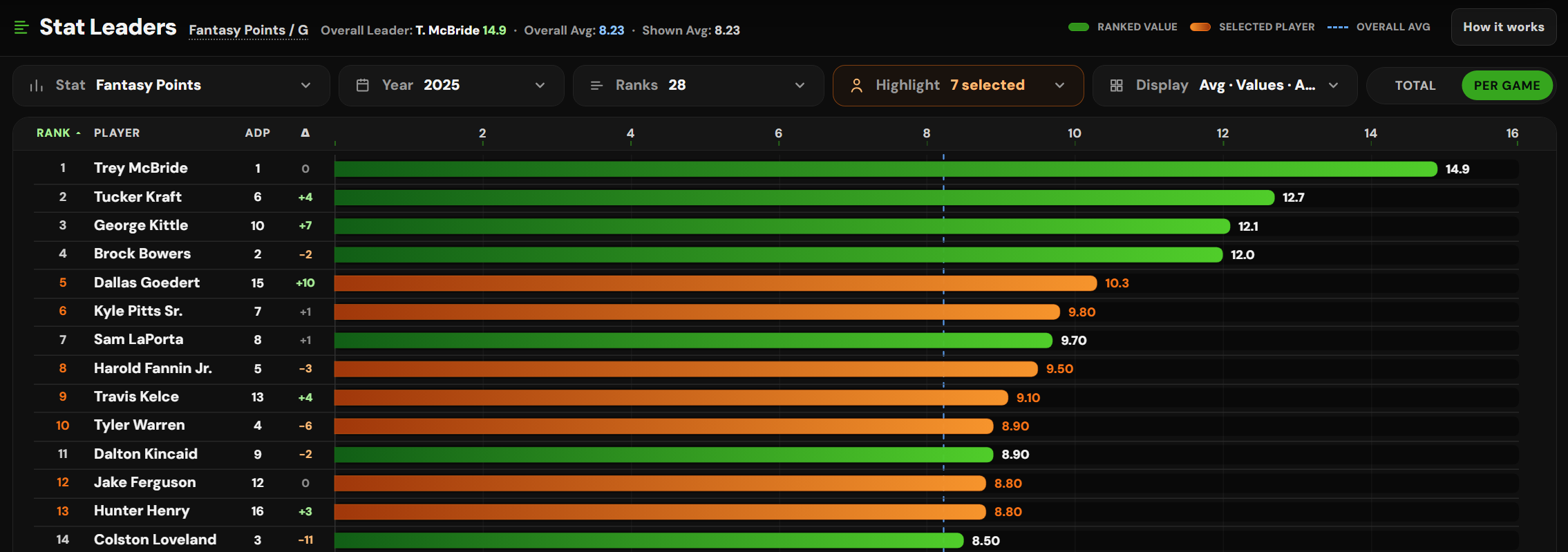
If you drafted McBride last year you were outscoring your league mates at the TE position by 4-6 PPG, even if they had the next best players who were fully healthy. That’s a monumental advantage, but of course there’s a tradeoff. By drafting a TE in the Round 2 or 3, you’re sacrificing drafting a RB/WR in that range that could be a real difference maker (2025 JSN and 2023 Amon-Ra St. Brown are the 2 most recent examples of this). There’s a healthy balance of risk and reward, but this article is catered to all types of players, regardless of whether you’re the diehard early TE fanatic, the “it depends on the player and the price” player, or the “I draft my TE late every year without fail and hope for the best” type of player (usually me), this article will hopefully give you an early TE pessimist’s more optimistic view on the strategy this year, as well as the reasoning behind which of the 2 candidates I’m high on and which I’m avoiding at ADP at all costs. Let’s dive in.
Trey McBride
Trey McBride was HIM in 2025. He was one of only 2 TEs to play at least 15 games and average 10+ PPG in half PPR formatting. Dallas Goedert barely snuck into this bracket, playing 15 games with a 10.3 PPG average. McBride played the full 17 game season and averaged a monstrous 14.9 PPG, a full 5.1 extra points every single game than TE2 Kyle Pitts managed to haul in. To put into perspective just how dominant he was, in the history of fantasy football, the only TEs to outproduce McBride’s 252.9 point 2025 season were Rob Gronkowski in 2011, Jimmy Graham in 2013 and Travis Kelce in 2020 and 2022. That’s the fantasy peak of both the Brady-Gronk and the Mahomes-Kelce eras, and McBride was right up there with those all time great performances. So obviously you’re thinking “Wow Cushy, Trey McBride is not only at his personal peak, but he’s within touching distance of the historical peak of the TE position. SURELY you’re not about to segue into why he’s the guy you’re avoiding at ADP, right?” Well without further ado, I’m about to segue into why Trey McBride is the guy I’m avoiding at ADP.
Offensive Coordinator Change
First and foremost I need to make something clear… I’m avoiding McBride AT ADP, not overall. If he magically falls to the 4th round, I will welcome him onto my roster with open arms. On ESPN, Sleeper, Yahoo and Underdog, his ADP across all 4 sites averages out at 2.12, coincidentally the exact same as his counterpart Brock Bowers. Fantasy football players in 2026 are effectively being asked to predict which of McBride and Bowers is more likely to replicate Trey McBride’s 2025 season. It seems counterintuitive to suggest that the answer isn’t McBride, but hear me out and I’ll give you a handful of reasons why I’m just not as bullish on the reigning TE1 this time around.
Let’s start with the OC situation, which in a practical sense is hard to directly correlate to a prediction of declined production for McBride, but it’s worth talking about. It’s hard to view this factor as predictive because Arizona’s departed OC Drew Petzing has only ever had McBride as his starting TE in his time as an offensive play caller in the league. In his 3 years with the Cardinals, McBride ranked 6th (2023), 2nd (2024) and 1st (2025) in targets, so the question is, was that down to Petzing being known for getting the most out of his TEs, McBride getting the most out of his offensive play callers regardless of how good or bad they are, or a bit of both? I’m far more interested in the newly appointed Cardinals’ OC, Nathaniel Hackett’s production history with TEs during his long tenure in the league as the offensive play caller for each respective team he coached.
Want to see the stats? Of course you do.
Buffalo Bills OC (2013-14)
2013 - Scott Chandler: 102.0 FP (TE17), 6.4 PPG, 15th in targets
2014 - Scott Chandler: 91.2 FP (TE21), 5.7 PPG, 20th in targets
Jacksonville Jaguars OC (2016-18)
2016 - Julius Thomas & Marcedes Lewis (split games due to injury): 100.0 FP (TE21), 6.3 PPG, 20th in targets
2017 - Marcedes Lewis: 75.8 FP (TE25), 4.7 PPG, 29th in targets
2018 - James O’Shaughnessy: 22.6 FP (TE54), 2.5 PPG, 35th in targets
Green Bay Packers OC (2019-21)
2019 - Jimmy Graham: 81.7 FP (TE22), 5.1 PPG, 18th in targets
2020 - Robert Tonyan: 150.6 FP (TE4), 9.4 PPG, 24th in targets*
2021 - Josiah Deguara: 49.0 FP (TE41), 3.5 PPG, 42nd in targets
Denver Broncos HC (2022)
2022 - Greg Dulcich: 69.6 FP (TE23), 7.0 PPG, 22nd in targets
New York Jets OC (2023-24)
2023 - Tyler Conklin: 92.6 FP (TE20), 5.4 PPG, 13th in targets
2024 - Tyler Conklin (through 5 games before Hackett was fired): 26.6 FP (TE14), 5.3 PPG, 8th in targets
*Robert Tonyan’s TE4 season was due to insane over-efficiency. He had less targets than George Kittle, who played 8 games compared to Tonyan’s 16, but Tonyan led the TE position in touchdowns and was scoring one every 5.3 targets he amassed, which is a complete outlier. He was only targeted on 11.8% of all Packers’ passing attempts.
All of this is to say that apart from one fluke outlier season, Hackett’s history with TEs is undeniably abysmal. Bear in mind that McBride is head and shoulder above any TE Hackett has coached in terms of talent, so I don't think that McBride’s production will dip to the levels you see above. I do however think that going from a pass happy offense and OC that at the very worst was willing to spam him with targets, to an OC who hasn’t had his starting TE finish top 12 in targets over a full season could limit the ceiling outcome for McBride.
2025 Overusage
Trey McBride ran an absolutely absurd number of routes in 2025, 667 to be exact, leading not only the TE position, but the entire league. The next highest number of routes run by a TE in 2025 was Travis Kelce with 511. Meanwhile, Mark Andrews’ 602 routes run in 2021 is the 2nd highest over the last 5 years. In that same time span, the average starting TE runs roughly 25-30 routes per game (425-510 in a season). McBride in 2025? 39 routes per game. Let’s say across a 17 game season, a TE runs the higher end of that of 30 routes per game for 510 across the season, right where Kelce was in 2025 as the TE2 in routes run. McBride ran 157 extra routes above the average, and if we divide that 157 by 30, we have 5 extra games worth of routes run by the TE1 last year. That’s like playing an entire 4-5 games from running an above average number of routes every single week.
In our 2nd ever podcast episode back in March, which you can listen to on Spotify and at https://www.thefantasycompass.com/podcasts/ we discussed Jonathan Taylor’s 2025 usage, and explained with historical data that RBs that have been “overused” if they reach 370+ touches the prior season and tend to have a dip in production the following season, from injury or regression in their volume. Normally for a RB to amass 370+ touches, there’s at least one rare and circumstantial reason behind it. I believe that rare and circumstantial reason can be applied to Trey McBride’s 2025 season, given that 667 routes is head and shoulders above anything we’ve seen from the TE position in the last 5 years.
Not only did he have the most TE friendly QB of the last 5 years, but also Arizona’s run game was effectively non-existent with all their injuries. They ranked 31st in the league in total rushing yards, and because of the fact that they were losing almost every week (1 win in their last 15 games), they were passing the ball at an insane rate (1st overall in the league in passing attempts). Let’s put this into perspective for a second. In 2025, where their respective team lost a minimum of 10 games, here are the leaders in targets per game (TGT/G):
Not only did he have the most TE friendly QB of the last 5 years, but also Arizona’s run game was effectively non-existent with all their injuries. They ranked 31st in the league in total rushing yards, and because of the fact that they were losing almost every week (1 win in their last 15 games), they were passing the ball at an insane rate (1st overall in the league in passing attempts). Let’s put this into perspective for a second. In 2025, where their respective team lost a minimum of 10 games.
Here are the leaders in targets per game (TGT/G):
- J. Chase - 10.4 TGT/G (10 losses)
- T. McBride - 10.1 TGT/G (14 losses)
- C. Olave - 9.2 TGT/G (10 losses)
- W. Robinson - 8.3 TGT/G (13 losses)
- M. Wilson - 8.1 TGT/G (14 losses)
McBride led the whole league in targets during games where a player’s team lost (142), which in itself makes sense because the Cardinals were tied for the most losses in 2025, but when you learn that 2nd place in that category was fellow Cardinal Michael Wilson with 114, you realize the extent of how much more their team was passing the ball than everyone else. In the 3 games Arizona won, McBride’s TGT/G dropped to 7.7, albeit the sample size is small and 2 of those 3 games were with Kyler where McBride’s targets were generally few and far between. It’s hard to say that McBrides fantasy success is only due to his team losing a majority of the time which leads to significantly higher targets than expected. Will that trend continue in 2026 though? Let’s take a look and find out.
Offseason Moves And 2026 Expectations
The Cardinals want to balance the scales a bit offensively, which is why they made a big statement drafting the highly touted RB prospect Jeremiyah Love with the 3rd overall pick in the 2026 NFL draft. Gone are the days of Emari Demercado dropping the ball right before running into the endzone for a 72 yard touchdown. We expect a more balanced approach from the Cardinals’ offense in 2026, which could certainly decrease the number of routes McBride will run.
To circle back on McBride’s production when his team is losing vs winning, there’s some positive outlooks for him this year. According to Warren Sharp's schedule analysis, the Cardinals have the hardest overall schedule for 2026. Largely due to sharing a division with 3 playoff calibre teams that include the Super Bowl champions Seattle Seahawks and a tough AFC West division, particularly the Broncos, Chargers and Chiefs (sorry Raider Nation). There’s a high probability the Cardinals are a bottom 5 team again, which may lead to the same “sling the ball” all game mentality if forced to keep up with their opponents.
Potential QB Carousel
Jacoby Brissett signed a new one year deal worth $15.5 million, retaining his starting spot for the time being. This is great for McBride, given that Brissett is known to target his TEs aggressively. In 2025, 33% of his targets went to a TE, and I mean sure, Brisset had arguably the best TE in the league so why wouldn’t he? It gets more interesting when you realize that from 2021-2025 his TE target percentage was still 31% and leads the league ahead of Lamar Jackson at 30%(Andrews) and Patrick Mahomes at 29%. This bodes well for McBride, but the question is what if the Cardinals have another poor season? We discussed how they have the toughest schedule and they just drafted Carson Beck with the first pick in the 3rd round of the draft in April. We’ve seen it before where teams who are well out of playoff contention sub in their rookie in the late stage of the season to assess the talent they have over the final few games (eg: Kirk Cousins benched for Michael Penix in 2024, Tua Tagovailoa benched for Quinn Ewers in 2025). There’s a world where McBride could see a QB change around the fantasy football playoffs that creates uncertainty to his production at the most pivotal time of the season for managers.
My 2026 McBride Outlook
If you’ve read this far, you already know what I’m about to say here. I believe there is a low probability for Trey McBride to repeat his 2025 production. The negative game scripts will work in his favor, but there are so many factors I’m concerned about.
- Potential QB carousel during fantasy playoffs
- A heavy offseason investment into the run game
- The threat of the receiving room presenting more competition
- Workload effects on his health after playing practically a 22 game season.
Any one of these worries becoming a reality could have a damaging effect on McBride’s production in 2026, and personally I’m out on him at ADP. If he falls enough, I’ll comfortably take him, given if he manages to avoid the above concerns, I expect him to have a good season, finish as a Top 2-4 TE and still provide a big advantage over your league mates at the TE position. It’s just not a risk that I am willing to take, when the alternative option looks less risky. Speaking of which, let’s address said alternative option with Brock Bowers.
Brock Bowers
Yes….I know….I’m a Raiders fan and yes….I own a Brock Bowers jersey, but no, these aren’t the driving factors behind why I think he’s the clear choice for those who want to dabble drafting an early TE in 2026. Bowers’ 2025 season was doomed from the start when he suffered a PCL injury and a bone bruise in Week 1 against the Patriots. He played through the injury as much as possible despite missing 3 games. Later in the season, he was placed on IR to miss the final 2 games. He’s fully healthy now, so no injury concerns remain heading into the season. With Bowers missing 5 games, and McBride effectively playing 5 extra games, there’s no denying that Bowers will be at the very least a little fresher coming into the 2026 season. I’ll give him a point over McBride in terms of who is less likely to suffer from physical burnout in 2026.
The Raiders’ Offense
If you thought a receiving room of Marvin Harrison Jr. and Michael Wilson made for easy pickings for Trey McBride, wait until you see who the Raiders have ‘competing’ with Bowers for catches. Jalen Nailor, Tre Tucker and Jack Bech. Not a single top 36 fantasy WR season among them. Bowers’ total points last season despite missing 5 and a half games was higher than any single season put together by anyone in the Raiders’ WR room. Pair that with the fact that the Raiders got a decent QB upgrade, moving from the disastrous Geno Smith to the less disastrous, slightly steadier Kirk Cousins, along with the actual #1 draft pick in Fernando Mendoza, and there’s a lot of reason to believe that Bowers could come straight out and dominate in 2026. If it couldn’t get any better for him, he’s now free of the Pete Carroll offensive system, and is now in the safe hands of Super Bowl 60 winning offensive coordinator Klint Kubiak. The new Raiders HC recently described Bowers as “a football robot from heaven”, and will make him the center piece of his offensive scheme. Speculation suggests that Kirk Cousins will hold the starting QB job for the Raiders for most of if not the whole season in 2026. For all of his flaws, Cousins is very good at one specific thing: feeding his #1 target. In 2024, Drake London had a 24.6% target share on the Falcons while Cousins was active, ranking 9th among players who played at least 14 games across that 17 game season. Justin Jefferson on the Vikings the 2 years prior? 26.0% and 26.6% target shares. Similarly to McBride, there’s a chance that Cousins takes a back seat to Mendoza at some point during the season, but I have much more belief in Mendoza’s talent as the number 1 overall selection, than I do in Beck’s.
My 2026 Bowers Outlook
Brock Bowers' section is noticeably shorter than McBride’s, and I believe that’s reflective of the difference in complexity of each player’s situation this year. Bowers has arguably the biggest disparity in talent between himself and the other receiving options around him on the Raiders. Coupled with taking the Super Bowl winning offensive play caller from Seattle and a QB who has a proven track record of hammering his best player with targets, Bowers is as good a bet as any to be a league winning asset.
Puka Nacua broke the rookie single season receptions record in 2023 with 105 catches only for Bowers to top it the following year with 112 catches to snatch the record for himself. My bold prediction for the 2026 season is that Bowers will beat McBride’s record for the most receptions by a TE in a single season. Breaking records isn’t easy by any means, but I think he will not have an easier path to achieving it then the situation he finds himself in for 2026.
Conclusion
McBride and Bowers are both elite talents at the TE position, but for me there’s a clear leader to have the next elite performance. With a lot more variables in McBride’s outlook, it’s hard to warrant spending a late 2nd round pick on him, when I can instead draft a guy with little to no concerns regarding his team situation. For what it’s worth, I don’t think drafting McBride is going to cost you any chance of winning your league, but upside is what we’re aiming for. In my opinion the TE with the highest upside is Brock Bowers, and he is who I’m recommending if you’re drafting an early TE in 2026.